How do you get food?
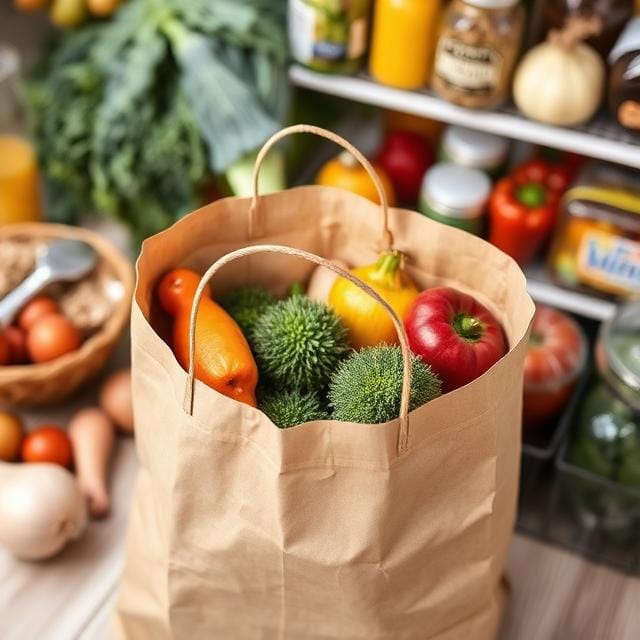
Here is how you get food.
You can produce food.
You can produce food, which is an organization of chemical compounds.
Food Production historically involves hunting, gathering, agriculture, and labs.
You can find food when it is distributed.
You can find food when it is distributed from the source of production.
Food Distribution is a process which involves food storage (e.g., in a silo, warehouse) and the transportation of food (e.g., via foot, bike, car, train, plane).
You can find food where it is exchanged.
You can find food where it is exchanged (e.g., stores, events, break rooms).
There are multiple places where food is stored away from the source of production.
These places let a consumer exchange food for money with a service provider.
Here are examples where an exchange of food occurs.
- A store lets you exchange food for money.
- A food bank lets you exchange food (often when certain requirements are met).
- A company may order catering for an event where food is stored.
- A company may store food in a break room which employees access.
- A house may store food in a pantry.
You can find food where it is discarded.
You can find unused food where is discarded (e.g., as a gift, in a trashcan).
Food Loss after the food is produced can occur at any point during food distribution.
Here are reasons why unused food may be discarded in a capitalistic system.
- Food may be discarded to manipulate prices in a market.
- Food may be discarded because the cost of food distribution is not worth the gain of selling the food (often away from the source of production).
- Food may be discarded because there is a lack of demand in the market for the food, and the cost of food storage is not worth the gain of selling the food later.
- Food may be discarded for legal reasons enforced by government policies.
- Food may be discarded because it does not look as expected.
- Food may be discarded because it is expired or perishable.
- Food may be discarded because it has been tampered with.
- Food may be discarded as a gift to another person.
What concerns do you have when dealing with discarded food?
You should determine why the food was discarded when dealing with discarded food.
Food which is discarded due to the cost of distribution.
Food which is discarded due to the cost of distribution will not be distributed to you. So, you must determine whether the cost of transportation to the food is worth the value.
Here is an example.
You would not spend $5 for a gallon of gas to find a $1 food item. Instead, you may spend time to walk for $1 food item when walking to the store does not cost you $1 (e.g., in calories when you want to gain weight).
Food which is discarded due to lack of demand.
Food which is discarded due to lack of demand is not wanted where it is exchanged. This discard does not mean the food is worthless, but that the audience exposed to the food did not demand it.
This food is a “capitalistic leftover” which does not directly reflect a food’s quality or nutritional value. However, you can argue for a correlation between the price of food and its quality when you review food prices in relation to macronutrients: You find foods with higher amounts of complete proteins (containing all amino acids) cost more than foods without any complete proteins.
Your concern when dealing with a “capitalistic leftover” is confirming the discarded food was a monetary liability to its previous owner and not “junk food/poison”.
Food can be discarded due to monetary liability when the owner did not promote the food among the right audience.
Suppose the target audience of a store is middle-class.
An item in the store
- which is popular among lower-class people
- is likely to be discarded while unused
- due to a lack of demand among middle-class customers.
What stops you from reselling this unused and discarded item to the lower class?
Your redistribution of the food to another audience (e.g., lower-class) is equivalent to an outbound sales operation (reselling). You earn monetary value by connecting the lower-class to the food, and this redistribution costs you energy.
You can reclaim food.
Food Waste Valorization (“Food Diversion or Recovery”) is when you perform a set of actions with food or other items to get other foods.
Here is an example of food waste valorization with discarded food.
- You use discarded bread as bait to hunt a bird.
- You use discarded bread in exchange for cash or credits, then use this currency to buy a specific food.
- You use discarded food to create a biofuel, which is used for any other purpose.